
Confronting Anger, Shame, and Guilt
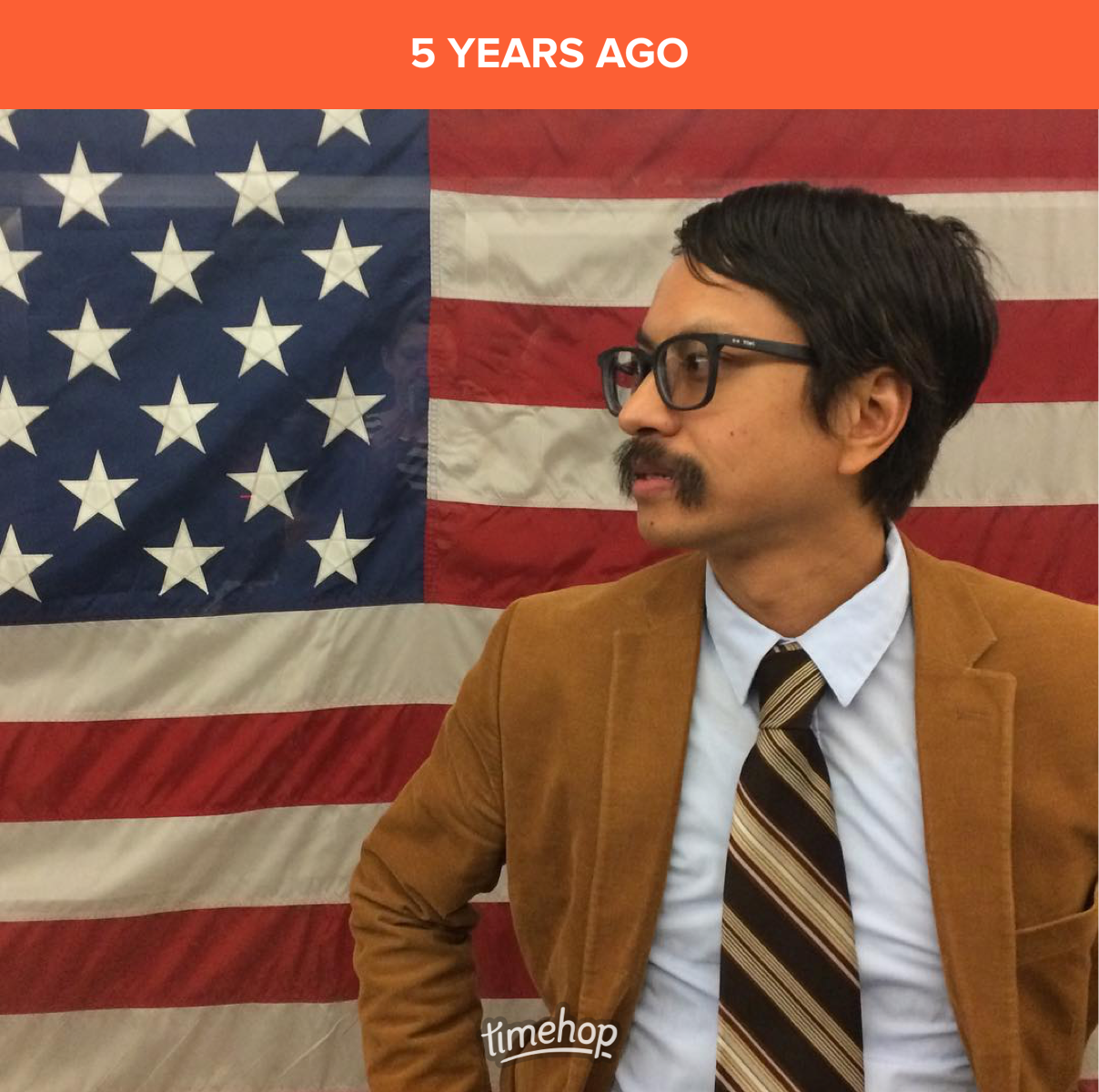
The day of my naturalization ceremony in March, 2016.
A few years ago, I worked at Blick Art Materials in Evanston, IL, right outside of Chicago. As I was stocking the shelves, I unpacked a box of figurines. Seeing each doll was like a punch to the gut. These tiny plastic toys were of various Asian characters with racially stereotypical features. One figure wore block sandals and peasant clothes. The attire didn’t offend me, but his facial expressions and headwear did. The character had pronounced buckteeth, very slanted eyes, and a circular straw hat, the kind you would see workers wearing in a rice paddy. The other character was of a Japanese woman in a kimono. Once again, the attire wasn’t offensive, but rather the overall appearance of the doll was. The figurine had a white powdered face, tiny red lips, and very slanted eyes. She appeared diminutive and submissive. When I brought this to the attention of my boss, who is white, she thought I was overreacting. I had to explain to her why these racist caricatures perpetuate stereotypes, of which I’ve faced throughout my life.
At that time, I didn’t have the language to discuss hegemonical power structures, complicitness, social identity, internalized oppression, institutional racism, or any of that. And frankly, even if I did have the language, I don’t know if I would still be able to discourse upon it objectively with emotional restraint. I simply demanded that we remove these items from the store and across the chain. My boss took me off the sales floor and offered me a few minutes to calm down. Meanwhile, she called her regional boss and explained the matter to him. A few minutes later, she brought me into her office to explain the outcome of her conversation with him. She said that the company has stores all over the U.S., including in regions with large Asian-American populations such as the Bay Area, and that no other person has called to complain about these items. She was authorized to remove the items from our store, which she did, but the company would not remove them from any other store. I was also told to take the rest of the day off. I really wasn’t satisfied with the outcome, it just didn’t make sense to me, and I didn’t know how to communicate that to the company. Anger, shame, and guilt formed a pit in my stomach.
In the 1990 book Asian American Experiences in the United States, various Asian Americans briefly talk about their experiences and feelings from the out-group perspective of first- to fourth-generation immigrants. Japanese-American Henry Moritsugu pinpoints how I felt, “You go along for days, weeks, months, thinking you are one of them, then something happens to cut you short, so you really have to be on guard. I think we all have identity crises at some point” (Lee, p. 99). As an Asian American, I’m continually constructing and reconstructing my identity, almost entirely from the out-group perspective. Like Moritsugu explains, we get to a point of complacency until someone or something reminds us that we are different from the dominant group in the U.S. In this essay I re-analyze the incident above to address the origins of the anger, shame, and guilt I felt. Then I examine my praxis orientation that has resulted from this reflection. Finally, I suggest ways for how we should move forward.
Meaning Is Encoded from Past Experiences
My initial reaction to this unexpected confrontation of racial imagery at work was shock, then the expectation to sell the figures produced anger. I tried explaining to my boss that it was stereotypes and imagery like these that have peppered my existence to remind me that I was different. What I didn’t comprehend at the time was that from her position of white privilege, she didn’t understand how the imagery was harmful. As Allen (2011) writes, “Understanding white privilege also may help people of color understand why some white people seem oblivious to the issues that frequently occur for people who are not white” (p. 87). From this perspective, institutional racism allowed patterns of Asian stereotypes to emerge and persist. Meanwhile, through the lens of white supremacy, these images are deemed innocuous, because they don’t affect the dominant group. Also, when my boss thought that I was overreacting, she was trying to minimize or negate my feelings. These actions make me question my own identity and wonder if I am making a big deal out of things. The doubt then becomes internalized oppression, where I do think that I am the problem. This results in shame for my inability to assert or understand my Asian-American identity.
One time when I was six or seven, my brother (who is two years older than me) and I were sitting in the back of my stepdad’s pickup truck in the parking lot of a grocery store while our parents where inside shopping. We were minding our own business when two white boys, who were similar in age to us, came up to the truck and then pulled at the corner of their eyes and sang, “Chinese Japanese, dirty knees / Look at these!” This is one of the earliest experiences I remember in which the dominant culture had to remind me that I was an Other. Even though my stepdad was white, and my mother was Thai, we never discussed race. Therefore, at the age of six or seven, I hadn’t constructed an Asian identity or thought of myself as different.
It wasn’t until I was nine-years old that my mother actually explained to me why I had a white father and why my two younger sisters were half-white. However, my mother never received an education past the 4th grade in Thailand, and in America she had to take night courses to learn English. She never learned the words to talk about race, class, or inequality. Instead, she taught me about culture and tradition which informed specific aspects of my emerging Thai identity. As my Thai identity was forming, hers was changing. Unfortunately, my mother’s transition to America was completely immersive. There was no Thai community for her to communicate with. Although she acculturated through integration, she eventually lost her ability to speak Thai; therefore, her children never learned Thai.
A few years later, I attended a county-wide business symposium for high school students. I was in a breakout group with some kids from another high school when these girls in my group just came up to me, squinted their eyes, pressed their palms together, and started jabbering at me, “ching chong ching chong ching chong.” They thought it was hilarious. My face grew hot. So, how am I not supposed to feel shame, when every so often, someone has to remind me that I am not one of Them in the most basic way possible?
Last year, before the Pandemic, I flew to Latrobe, Pennsylvania to attend my friend’s wedding. The night before, I had some time to kill, so I walked over to a sports bar next to my hotel. The place was very busy, loud, and crowded. Everyone seemed to be having a good time. Twenty minutes into my beer, it dawned on me that, in this very crowded bar, I appeared to be the only person of color. A shot of fear went through me. The intersections of my situation: working-class town, masculine sports bar, and late-night drunken whiteness reminded me all-too-well of how easy misinterpreted looks and aggressive tension could place me in danger. Stories of Matthew Shepard, Emmett Till, and post-911 violence raced through my mind. So, I ordered some food to go and left as quickly as I could.
White privilege means that you never have to experience these things. You never have to feel shame for suddenly being reminded that your skin color is different. White privilege, or even dominant-group privilege, means that you can say “I don’t see color,” but not actually confront what that means. White privilege also means that you don’t have to be afraid that your salient identity marker might single you out as a potential victim for violence. How could I explain any of these things to my white bosses who very well could have claimed colorblindness during this first year of Obama’s supposedly post-racial America?
This inability to relate my experiences and argue against racism with my bosses resulted in guilt. I felt guilty because I didn’t know how to pragmatically confront these issues in a productive way. I also felt guilty because I accepted my bosses’ decision to pull the figurines from our store, but to allow their sale across the chain. The only thing I accomplished was to make myself look overly sensitive.
One perspective I never considered in this work situation was the power-over dynamic. My white bosses had the power-over me to resolve the conflict, to which I could choose to accept. I was not in a position to negotiate, or resist, for fear of losing my job. As America entered the Obama administration, the recovery to financial collapse had barely started. After being laid off from my previous job and five months of unemployment, I had finally managed to find this job. I didn’t have the privilege of making a stance, especially in light of my bosses’ use of moral relativism to guide their decision. Their moral logic was thus: I found something racist in our inventory, no one “over there” (where other Asians were) complained, so it wasn’t absolutely racist. Now that I know these terms, I could say that my feelings of guilt and shame stemmed from my consent to the hegemony, which made me complicit in my own subjugation.
With Knowledge Comes Power
If this incident were to occur today, I might have done things a little differently. First, I would have a better vocabulary and understanding of difference matters. I would explain that negative racial imagery persists only because the dominant group allows it to. Perhaps, they thought the images were cute or funny, and not racist. Then I would have to explain that images alone aren’t racist, but when images are encoded to signify essential personality traits based on inherited physical characteristics, such as the shape of the eyes or mouth, to produce systemic inequalities to privilege one group over another, and when these depictions are codified in over a century of texts, then yes, these images are racist. From their position of white privilege, they might not understand the impact that these racial images have on someone who has constructed an Asian identity; therefore, I might use the stories above to establish how racist actions are directly linked to the images of these figurines.
Likewise, I would give them an opportunity to be an ally, to use their position of power to break this pattern of accepted racial imagery that is so entrenched in our society. I would make the argument of moral absolutism versus moral relativity: are these figurines absolutely racist or only racist if someone is hurt by them? And finally, I could resist through the democratic outlet of social media. Today’s woke culture is quick to address inequities and form alliances. I might lose my job through social media exposure, but then again, through alliances and networks, I might be offered a new job. There are so many actions that I could take, but they all come from a position of knowledge and cultural competency, which I did not possess then.
Reflections and Shifting Constructions
Immigrants experience a state of liminality, an identity caught between two nations, without being fully accepted by either. This feeling came to the fore when I returned to Thailand for the first time a couple years ago. Unfortunately, my family is not really close in regard to feelings and emotions, so we rarely discuss our identity issues with one another. I have a young-adult niece who is part-Thai, white-American, and Mexican. Recently I tried to engage in conversation about identity with her, but unfortunately, at 21-years old, she wasn’t ready for any critical discussions and casually changed the subject. Perhaps it wasn’t her age that affected the course of the conversation, maybe it is the culture of my family lacking the abilities to verbally discuss identity issues. Her mother, who is my half-sister, is half-white and half-Thai. Although she has the means to travel, she hasn’t been to Thailand yet. A while ago year she went to New Zealand to attend a concert. New Zealand is so close to Thailand, that I suggested she should just make the excursion. Although she communicates a proud Thai identity, I don’t think she is ready to confront this aspect of her self yet. Her light skin allows her to be part of the dominant group here in the States, but she would be part of the out group in Thailand. This dynamic aspect of status is an example of the privilege/disadvantage dialectic of identity, and how we are continually constructing and reconstructing our social identities. Even when I was in Thailand with my white-American partner, our identities were constantly shifting. I learned enough of the language to privilege me in certain situations, but lack of fluency disadvantaged me in other settings. Meanwhile, my brown skin gave me an immediate privilege based on visual assumptions. My partner’s identity was somewhat static as an American tourist.
Recently I moved to Berkeley, California where the culture is more heterogenous than the incident sites I mentioned above. Although I don’t feel 100% privileged now, I definitely don’t feel disadvantaged anymore because of my racial identity. I do feel that I am empowered now by the knowledge of difference matters to address social inequity. Maybe we can’t get everyone to take a course on communicating differences, but I suppose that with everyone we communicate, we can try to impart some aspects of cultural competency. At a past Thanksgiving dinner, a white-British man was complaining about some classic story being retold through the lens of a woman. He complained about why they had to change the gender of the characters. I replied, “We already have enough stories from the perspective of the patriarchy, let someone else have a voice.” This nonconfrontational response seemed to resonate with him and everyone else at the dinner. He said, “Yeah, you’re right.” People are ready to understand different perspectives, we just have to remind them why it is necessary.
References
Allen, B.J. (2011). Difference matters: Communicating social identity (2nd Ed.). Long Grove, IL: Waveland Press.

Lee, J.F.J. (1991). Asian American experiences in the United States: Oral histories of first to fourth generation American from China, the Philippines, Japan, India, the Pacific Islands, Vietnam and Cambodia. Jefferson, NC: McFarland & Company.
 stackofokcats
Great article! Perhaps one day, we can chat about how I have always identified with the Thai culture, but was saddened by how it was slowly slipping away once we immigrated to America. I have also recently found my biological father, who turns out to be a white man from Alabama, and how that has also affected me! 😃 Cheers cuz! Love you!❤️
LikeLike
Fantastic article, one I relate and identify with. Racism is an ugly mind altering illness. It occurs to different races, except from the “all powered class” (that may be partially your word).
You have more power then you realize, people will listen to you and take you seriously. Speak out and defend yourself and how you feel; I do, when in a safe environment. You have an advantage, the US is predominantly patriarchal.
I could from my stand point and other peoples go on and on, but, this is not the forum. Perhaps I will get to Cali, I have 2 sons there or you will get, back, to Vegas, you have lots of “us” here.
I am extremely proud of you, although I deserve none of your credit.
Peace, Par
LikeLike